EN
 tr
 de
 fr
 es
 pt
 it
 nl
 ru
 uk
 pl
 ro
 bg
 el
 ar
 fa
 az
 tk
 uz
 kk
 he

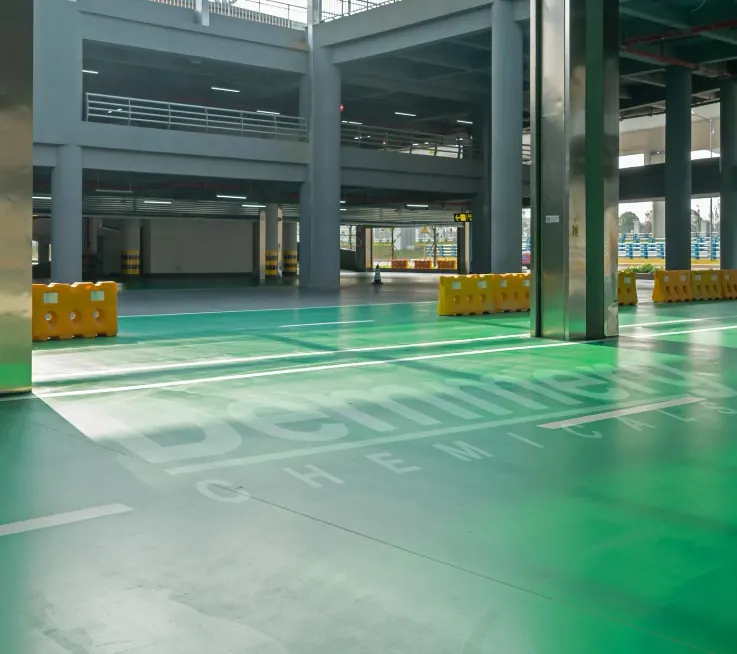
Short answer: a parking garage floor is built up layer by layer: surface preparation, epoxy primer, body coat, a UV-resistant topcoat where the floor gets sun, and line marking paint on top. In enclosed parking, the body coat is the self-leveling epoxy DEMCO EPOX 2000 SELF, whose data sheet lists parking garages, or the polyurethane DEMCO PUR 350, 360 or 363 SELF. On open decks, polyurethane self-leveling is protected with a UV topcoat (DEMCO PUR 412 TOP COAT UV); on rooftop parking, the spray polyurea DEMCO POLYUREA /PURE or /HB stands out. Ramps get non-sagging textured topcoats or the slip-resistant UV topcoat DEMCO PUR 413 TOP COAT UVS -R.
The consumption, thickness and time values below are taken from the technical data sheets of DEMCO products.
What wears out a parking garage floor?
- Abrasion: in practice, turning, braking and parking maneuvers constantly wear the surface.
- Oil, fuel and water: dripping oil and fuel stain the coating; rainwater and snow carried in by vehicles create a slip risk on ramps.
- Sun and weather: open decks are exposed to UV radiation, rain and temperature swings.
- Dust: uncoated concrete dusts.
The system, layer by layer
- Surface preparation: the surface is freed of oil, rust and dust, and no loose layer is left; glossy concrete is roughened by shot blasting, grinding or milling, and cracks and holes are repaired with epoxy filler. The data sheets of the epoxy and polyurethane body coats and topcoats require substrate moisture below 4% (see the concrete moisture guide). For polyurea, the substrate must have an average pull-off strength of 1.5 N/mm² and a compressive strength of at least 25 N/mm².
- Primer: on concrete, DEMCO EPOX 100 PR gives a dry film of 220–250 µm at 0.350–0.500 kg/m² in one coat. Epoxy can be applied over it after 2–4 hours; polyurethane is applied once the primer is touch-hard, about 24 hours later depending on ambient temperature. The fast system uses DEMCO EPOX 114 PR – FAST, and polyurea uses the moisture-barrier primer DEMCO EPOX 110 PR; their consumption depends on the substrate. All three primers are solvent-free and, according to their data sheets, can be used comfortably indoors.
- Body coat: this provides the main thickness of the floor. DEMCO EPOX 2000 SELF needs 1.6 kg/m² per 1 mm, the semi-elastic DEMCO PUR 350 SELF and the elastic DEMCO PUR 363 SELF 1.8–2.0 kg/m², and the elastic DEMCO PUR 360 SELF 1.6–1.7 kg/m² for about 1 mm; for spray polyurea the theoretical value is 1.1 kg/m².
- Slip-resistant and UV topcoats: the textured DEMCO EPOX 160 TIX and the semi-elastic DEMCO PUR 382 TIX give a dry film of 220–250 µm at 0.350–0.500 kg/m² in one coat. DEMCO PUR 412 TOP COAT UV is specified in the polyurethane self-leveling data sheets as one coat at 0.150 kg/m²; the aliphatic DEMCO PUR 410 TOP COAT UV /S and the slip-resistant DEMCO PUR 413 TOP COAT UVS -R give a dry film of 50–55 µm at 0.150–0.200 kg/m² in one coat.
- Line marking: on epoxy- or polyurethane-coated floors, DEMCO ACR 510 TOP COAT/S gives a dry film of about 50 µm at 0.150–0.200 kg/m² in one coat. The alkyd DEMCO ALD 700, whose data sheet lists parking areas, is applied to concrete and asphalt at 500–900 g/m² per coat, and the two-component DEMCO MMA 800, whose data sheet also lists parking areas, uses 4–6 kg of product for a 2–3 mm layer.
Enclosed parking
The data sheet of DEMCO EPOX 2000 SELF lists parking garages among its areas of use; the product withstands medium to heavy mechanical and chemical exposure, does not dust and gives a seamless, one-piece surface. Where a level must return to service quickly, choose DEMCO EPOX 2004 SELF/FAST, which its data sheet describes for floors that need to be opened to traffic fast. Where impact and elasticity matter, PUR 350, 360 or 363 SELF is used; their data sheets ask for the surface to be protected against scratching and soiling with one coat of PUR 412 TOP COAT UV indoors as well.
The data sheet of the polyurethane-cement hybrid DEMCO PUR 303 CONCRETE SL 23 UT/WB lists parking areas and basements; its slip resistance class is R10 (EN 16165) and it shows high resistance to fuels and to hydraulic and mineral oils. It must not be used on substrates affected by rising damp, and it may yellow over time depending on UV light and heat. For concrete that will not be coated, the lithium silicate hardener DEMCO HARTSCHÜTZER (generally 100–200 g/m²) is applied, followed by the acrylic concrete sealer DEMCO ACR 530 UV/S (150–250 g/m²); both data sheets list parking garage floors. ACR 530 UV/S contains solvent, so the area must be ventilated when working indoors.
Open decks and rooftop parking
In practice, epoxy yellows over time in the sun, so outdoors a UV-resistant polyurethane topcoat goes on top. The data sheets of PUR 350, 360 and 363 SELF ask for the surface to be coated outdoors with one coat of PUR 412 TOP COAT UV at 0.150 kg/m² to protect it from the sun. PUR 363 SELF works together with the substrate and is not affected by sudden temperature changes.
In practice, on rooftop parking above occupied space, the floor must also waterproof the structure. The data sheets of DEMCO POLYUREA /PURE and DEMCO POLYUREA /HB list parking garage floors and parking garage roofs; on parking floors, /HB is used with a suitable topcoat. Both are hot-sprayed by machine and become touch-dry within seconds. On surfaces under constant UV exposure, one coat of aliphatic polyurethane topcoat goes on top: PUR 410 TOP COAT UV /S and PUR 413 TOP COAT UVS -R are aliphatic, and their data sheets list application over polyurea. Details are in the polyurea guide.
According to the data sheets, epoxy and polyurethane coats must not be touched or come into contact with water for 24 hours after application; a polyurea surface is protected from water, dew and dust for at least 24 hours. In practice, falls and drain details are checked before coating.
Ramps
The self-leveling data sheets describe these products for horizontal floors; in practice, a self-leveling material can flow down a sloped ramp, so a textured topcoat is chosen. EPOX 160 TIX and PUR 382 TIX are thixotropic, do not sag on horizontal or vertical surfaces and give a slip-resistant surface thanks to their texture. On ramps exposed to the sun, PUR 413 TOP COAT UVS -R increases slip resistance by forming a rough surface. These data sheets give no slip resistance class; the class and texture are set in the project, preferably on a trial area.
Which system for which area?
| Area | Main loads | DEMCO system |
|---|---|---|
| Enclosed and basement parking | Abrasion, oil, dust | DEMCO EPOX 100 PR + EPOX 2000 SELF |
| Level that must reopen quickly | Short downtime | DEMCO EPOX 114 PR – FAST + EPOX 2004 SELF/FAST |
| Slip-resistant basement floor (no rising damp) | Slipping, fuel and oil | DEMCO PUR 303 CONCRETE SL 23 UT/WB |
| Uncoated concrete | Dusting | DEMCO HARTSCHÜTZER + ACR 530 UV/S |
| Open deck; enclosed level needing impact resistance and elasticity | Sun, rain, impact | DEMCO EPOX 100 PR + PUR 350, 360 or 363 SELF + PUR 412 TOP COAT UV |
| Rooftop parking above occupied space | Waterproofing, sun | DEMCO EPOX 110 PR + POLYUREA /PURE or /HB + PUR 410 TOP COAT UV /S or PUR 413 TOP COAT UVS -R |
| Enclosed ramp | Slipping | DEMCO EPOX 100 PR + EPOX 160 TIX or PUR 382 TIX |
| Open ramp | Slipping, sun | DEMCO EPOX 100 PR + PUR 413 TOP COAT UVS -R; if needed, over a polyurethane, polyurea or epoxy coat |
| Line marking | Visibility, traffic | DEMCO ACR 510 TOP COAT/S on coated floors; ALD 700 on concrete and asphalt, or MMA 800 where the area must reopen quickly |
For a general comparison of epoxy and polyurethane, see Epoxy or polyurethane?, and for the differences between marking paints, the road marking paint guide.
Frequently asked questions
How thick should a parking garage floor coating be?
DEMCO data sheets do not give a fixed total thickness; they give consumption per 1 mm: 1.6 kg/m² for DEMCO EPOX 2000 SELF and 1.8–2.0 kg/m² for PUR 350 and 363 SELF. The thickness is set in the project according to vehicle traffic, the condition of the substrate and whether the area is open or enclosed.
Can epoxy be used in an open parking deck?
In practice, epoxy yellows over time in the sun, so outdoors it must be topped with a UV-resistant polyurethane topcoat. The data sheet of DEMCO PUR 410 TOP COAT UV /S states that, where necessary, it can also be applied over epoxy coatings.
How is a parking ramp made slip-resistant?
On an enclosed ramp, the thixotropic textured topcoat DEMCO EPOX 160 TIX or PUR 382 TIX is used; on a ramp exposed to the sun, the rough UV topcoat DEMCO PUR 413 TOP COAT UVS -R. Because the data sheets give no slip resistance class, the class is set in the project.
When can a parking garage coating be opened to traffic?
The data sheets of DEMCO EPOX 2000 SELF and PUR 350, 360 and 363 SELF give no traffic opening time; these products and the UV topcoats reach full cure in about 7 days at 20–25 °C. DEMCO PUR 303 CONCRETE SL 23 UT/WB withstands heavy traffic loads after 48 hours at 30 °C; the marking paint DEMCO MMA 800 opens to traffic within 60 minutes. For the fast DEMCO EPOX 2004 SELF/FAST, the opening time is set with our technical team according to site temperature.
Can an existing parking garage floor be renewed without removing it?
That depends on the soundness, moisture and oil contamination of the existing floor. The data sheets of the UV topcoats (DEMCO PUR 410 TOP COAT UV /S, PUR 412 TOP COAT UV, PUR 413 TOP COAT UVS -R) list application over polyurethane, polyurea or epoxy coatings where necessary; our technical team inspects the floor and defines the surface preparation.
Describe the area of the enclosed and open levels, the ramps, the existing floor and how long the parking garage can be closed in the quote form, and our technical team will recommend a system for each area. For daily care, see the epoxy floor maintenance guide, and for all products, the flooring page.