EN
 tr
 de
 fr
 es
 pt
 it
 nl
 ru
 uk
 pl
 ro
 bg
 el
 ar
 fa
 az
 tk
 uz
 kk
 he

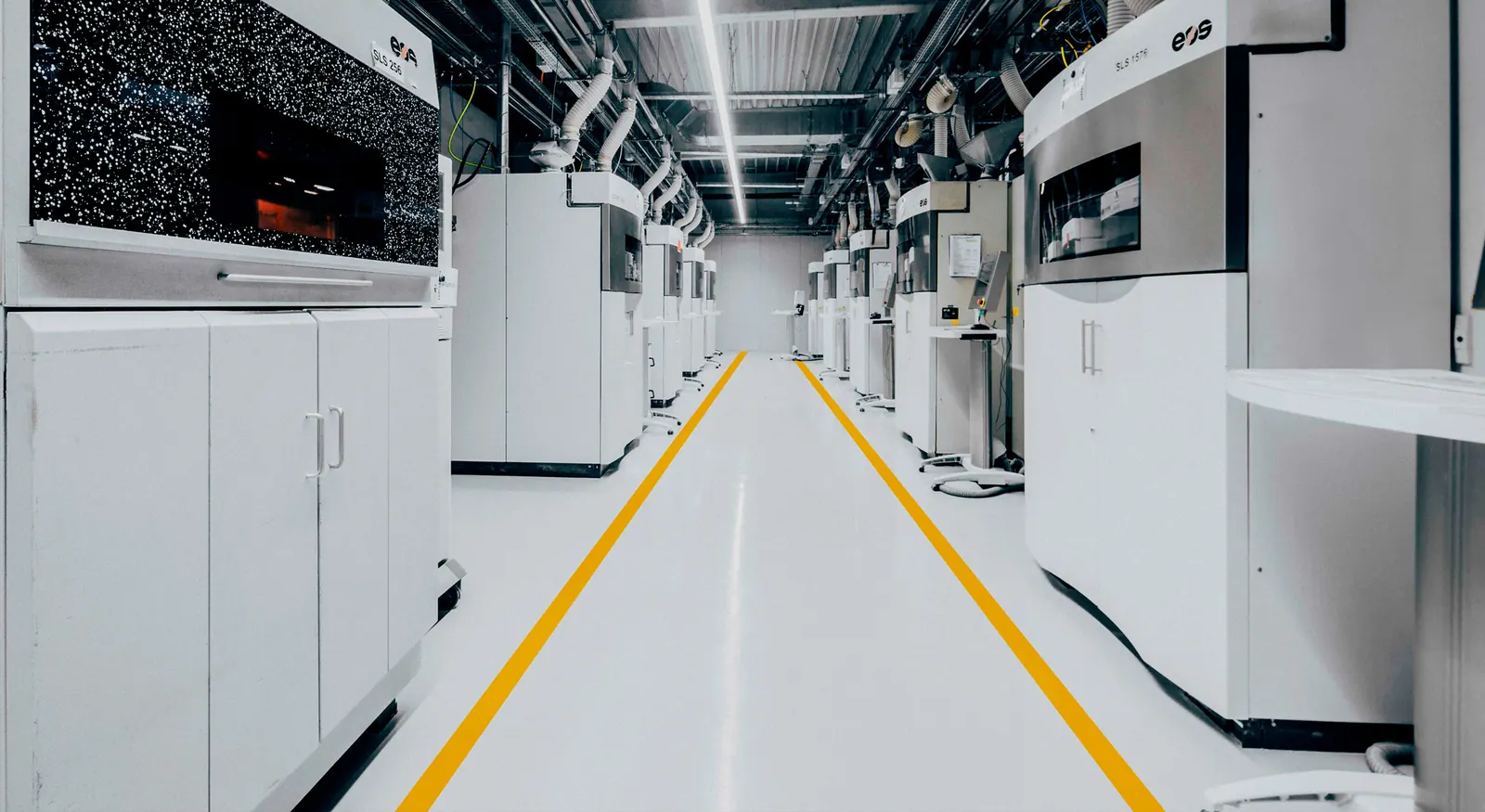
Short answer: An epoxy floor coating is made by mixing two components, a resin and a hardener; once applied to concrete, it cures through a chemical reaction into a seamless, single-piece coating. It is built from a primer, an optional mid coat, a self-leveling or textured body coat and a topcoat, and its types range from thin-film floor paint to coatings measured in millimeters. Most DEMCO floor epoxies are solvent-free; they are used in warehouses, production areas, laboratories, hospitals, food facilities and parking garages.
The values and limits in this guide are taken from the technical data sheets of DEMCO flooring products; for your project, always follow the product's current data sheet.
What is epoxy floor coating?
Epoxy is a two-component resin system: components A and B are mixed in the ratio given in the data sheet; for DEMCO EPOX 2000 SELF it is 80/20 by weight. For this product the mix stays workable for 50–90 minutes at 23 °C, then hardens and reaches full cure in about 7 days at 20–25 °C.
The result is a seamless wall-to-wall surface that does not dust, is hygienic and is easy to clean. The DEMCO EPOX 2000 SELF data sheet gives a compressive strength of 50 N/mm² and a Shore D hardness of about 76. According to its data sheet, the solvent-free primer DEMCO EPOX 100 PR contains no solvents or active substances and can therefore be used comfortably indoors.
Layers: what makes up the system?
An epoxy floor is a system of coats applied one on top of another; the coats are chosen according to the load the floor will carry, the chemicals it will meet and the surface required.
| Layer | Purpose | DEMCO example | Data-sheet value |
|---|---|---|---|
| Primer | Penetrates the capillary pores of the concrete, prevents dusting and makes the following coats bond to the surface | DEMCO EPOX 100 PR; on damp surfaces the surface-tolerant DEMCO EPOX 110 PR | EPOX 100 PR: 0.350–0.500 kg/m² per coat for 220–250 µm |
| Mid coat / scratch coat (optional) | Filled coat; increases impact and chemical resistance, and quartz can be broadcast into it | DEMCO EPOX 172 PR/F, DEMCO EPOX 2001 SELF/MID COAT | About 1700 g/m² per 1 mm |
| Body coat (self-leveling or textured) | The main service layer of the floor: a smooth, seamless surface or a textured, slip-resistant one | DEMCO EPOX 2000 SELF; for a textured surface DEMCO EPOX 160 TIX | EPOX 2000 SELF: 1.6 kg/m² per 1 mm; EPOX 160 TIX: 0.350–0.500 kg/m² per coat for 220–250 µm |
| Topcoat (optional) | Thin protective coat with a smooth finish; UV protection on surfaces exposed to sunlight | DEMCO EPOX 150 TOP COAT; on surfaces exposed to sunlight DEMCO PUR 410 TOP COAT UV/S | EPOX 150: 350–400 g/m² per coat for 220–250 µm; PUR 410: 0.150–0.200 kg/m² per coat for 50–55 µm |
Not every system has all four layers: a floor paint consists of a primer and a topcoat, and in self-leveling systems the top layer is usually the body coat itself. The order of application and the waiting times are covered in How to apply epoxy floor coating.
Types of epoxy flooring DEMCO makes
Self-leveling epoxy
A coating that is poured and spread, levels itself and is measured in millimeters. DEMCO EPOX 2000 SELF is designed for floors exposed to medium to heavy mechanical and chemical loads; DEMCO EPOX 2004 SELF/FAST can be opened to traffic within 5–6 hours at 20–23 °C, and DEMCO EPOX 2700 SELF is suitable for food contact.
Textured (orange-peel) epoxy
A thin, textured, slip-resistant coat that is spread over the primer with a trowel and then rolled; the data sheets classify it as a topcoat. Thanks to its thixotropic nature, DEMCO EPOX 160 TIX can also be applied to vertical surfaces; the water-based option is DEMCO EPOX 187 TIX/W. The differences are explained in Self-leveling or orange-peel textured floor coating?
Chemical-resistant epoxy
For floors exposed to highly concentrated organic and inorganic acids, bases, solvents and heavy chemicals. Over the primer comes the chemical-resistant primer DEMCO EPOX 125 PR/C, and on top either the self-leveling DEMCO EPOX 1900 SELF/C or the topcoat DEMCO EPOX 190 TOP COAT/C. The resistance list of the novolac epoxy DEMCO EPOX 192 NOVOLAC TOPCOAT includes 50% sulfuric acid and 35% hydrochloric acid; for prolonged contact, consult the technical team.
ESD and conductive epoxy
Systems that carry static electricity from the surface through conductors underneath to ground. The data sheet recommends the conductive primer DEMCO EPOX 195 PR/CONDUCTIVE (0.20–0.30 kg/m²) followed by DEMCO EPOX 2100 SELF/ESD (1.75 kg/m²); this product's resistance range is 1 × 10⁶ – 1 × 10⁹ Ω. Details are in the ESD flooring guide.
Decorative: metallic and terrazzo
DEMCO EPOX METALİK is a solvent-free epoxy for interiors whose special pigments create a metallic effect on the floor; it is applied in 1–2 coats at 0.5–1.0 kg/m² per coat. DEMCO EPOX 2400 TERRAZZO UV++ is a UV-resistant, colored epoxy binder that is mixed with aggregates such as natural stone, glass, mirror and seashells. More in Metallic epoxy and epoxy terrazzo.
Thin-film floor paints
Thin topcoats applied over the primer by brush, roller or airless spray. DEMCO EPOX 150 TOP COAT is for food-industry, warehouse, store and office floors that need a smooth finish; DEMCO EPOX 145 TOP COAT is suitable for food use. The water-based, odorless DEMCO EPOX 185 TOP COAT/W gives a 100–150 µm dry film at 0.250–0.300 kg/m² per coat.
Where is it used?
The main areas of use listed in DEMCO data sheets:
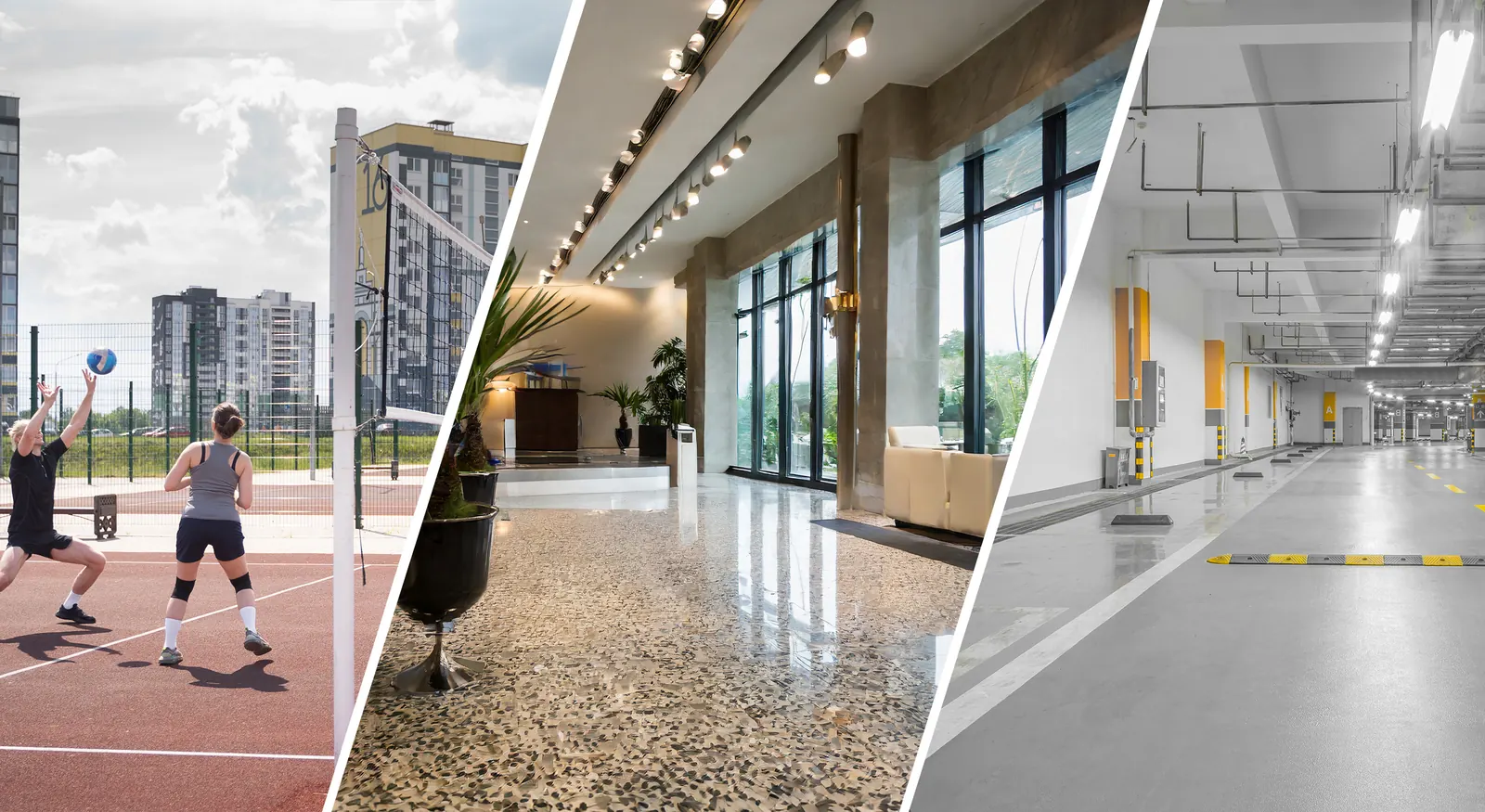
- Industry and retail: warehouses, production areas, aircraft hangars, parking garages, shopping malls and supermarkets (DEMCO EPOX 2000 SELF).
- Food, pharmaceuticals and healthcare: food processing plants, chemical and pharmaceutical plants, hospitals, laboratories and sterile production areas (DEMCO EPOX 2700 SELF); wastewater treatment plants (DEMCO EPOX 192 NOVOLAC TOPCOAT).
- Electronics and defense: electronic component production and test laboratories, lithium-ion battery plants and the defense industry (DEMCO EPOX 2100 SELF/ESD).
- Decorative spaces: stores, showrooms, offices and restaurants (DEMCO EPOX METALİK); metro stations, hotels, museums and airports (DEMCO EPOX 2400 TERRAZZO UV++).
Strengths and limits
Its strengths are a seamless, dust-free surface, easy cleaning and high mechanical and chemical resistance. Its limits are also stated in the data sheets (temperature and moisture values from the DEMCO EPOX 100 PR and 2000 SELF data sheets):
- Temperature: the ideal substrate temperature is 15–30 °C; it must never fall below 10 °C.
- Moisture: substrate moisture must be below 4% and ambient humidity below 80%; measurement and primers for damp concrete are covered in Concrete moisture before epoxy. DEMCO EPOX 192 NOVOLAC TOPCOAT must not be used on substrates with rising damp or without waterproofing.
- Vertical surfaces: self-leveling products (DEMCO EPOX 2000 SELF, 2700 SELF, 1900 SELF/C) and DEMCO EPOX 150 TOP COAT flow so well that they sag and run on vertical surfaces.
- Sunlight: DEMCO EPOX METALİK is not suitable for open areas or outdoor use; epoxy surfaces exposed to sunlight are finished with a UV-resistant polyurethane topcoat.
- Impact and thermal shock: if flexibility, impact or cleaning with hot water and steam is involved, polyurethane should also be considered; see Epoxy or polyurethane?
Frequently asked questions
Is epoxy floor paint the same as epoxy floor coating?
Both are epoxy; the difference is thickness. Floor paint is applied over the primer as a thin film: DEMCO EPOX 150 TOP COAT gives a 220–250 µm dry film per coat. A self-leveling coating is poured; DEMCO EPOX 2000 SELF needs 1.6 kg/m² of material for each 1 mm. For the effect on cost, see What determines floor coating cost per m²?
When can an epoxy floor be used?
According to the data sheets (e.g. DEMCO EPOX 2000 SELF), the surface must not be touched or come into contact with water for 24 hours after application; full cure takes about 7 days at 20–25 °C. The fast-curing DEMCO EPOX 2004 SELF/FAST can be opened to traffic within 5–6 hours at ambient and substrate temperatures of 20–23 °C.
Can epoxy flooring be used outdoors?
On surfaces exposed to sunlight, the system is protected with the aliphatic polyurethane topcoat DEMCO PUR 410 TOP COAT UV/S; according to its data sheet, this coat protects the surface against scratching, yellowing and soiling, and it requires ambient humidity below 65%. DEMCO EPOX METALİK is not used outdoors, whereas DEMCO EPOX 2400 TERRAZZO UV++ is described in its data sheet as UV-resistant.
Can epoxy be applied to walls?
Self-leveling epoxies are not applied to walls; they run on vertical surfaces. DEMCO EPOX 155 TOP COAT/DK was developed for walls, stair risers and coves; on vertical surfaces it is applied at no more than 400 g/m² per coat. The textured DEMCO EPOX 160 TIX can also be applied to both horizontal and vertical surfaces.
Can epoxy flooring be used in food facilities?
Yes. DEMCO EPOX 2700 SELF meets the limits of EU 10/2011 and TGK 2019/44 in overall migration analyses carried out to EN 1186, and DEMCO EPOX 145 TOP COAT, which is suitable for food use, can be used as the topcoat. For areas with thermal shock and hot-water or steam cleaning, the polyurethane screed DEMCO PUR 303 CONCRETE SL 20 UB/WB has been developed; details are in Food facility flooring.
Describe the intended use, the size of the area, the type of traffic and the condition of the concrete in the quote form, and our technical team will recommend suitable layers and products. Browse our flooring products for all systems, and for maintenance see Epoxy floor coating maintenance and cleaning.