EN
 tr
 de
 fr
 es
 pt
 it
 nl
 ru
 uk
 pl
 ro
 bg
 el
 ar
 fa
 az
 tk
 uz
 kk
 he

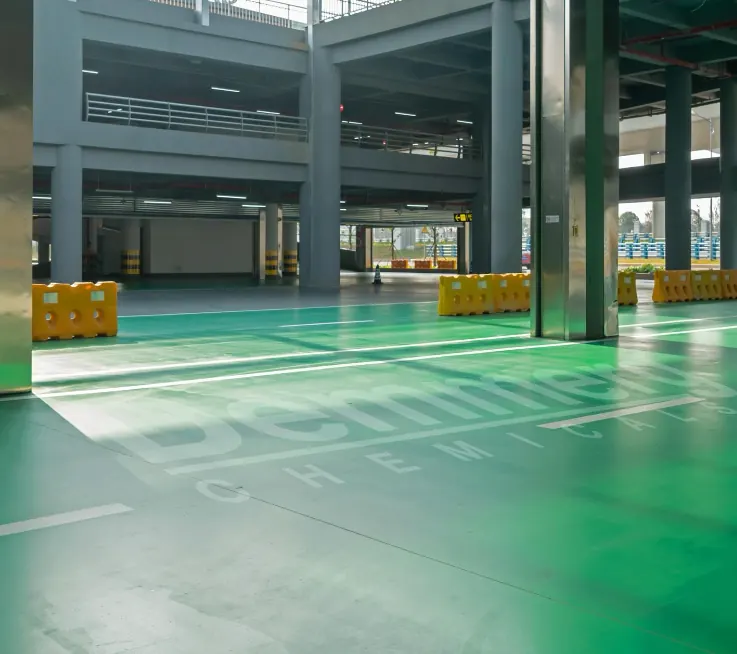
Short answer: a newly applied epoxy floor must not be touched or come into contact with water for the first 24 hours; at 20–25 °C it reaches full cure in 7 days on average. In practice, heavy cleaning and chemical loads start after this period; for daily care, sand and dust are swept up, the floor is washed with a neutral detergent diluted in water using a mop or a floor scrubber, and spilled chemicals are removed without delay. A worn topcoat can be renewed after the surface has been cleaned and sanded; cracks and holes are repaired with an epoxy repair mortar.
The values below are taken from the technical data sheets of DEMCO flooring products. Information marked "in practice" is not a data sheet value but common maintenance practice in the field.
When can a new coating be cleaned?
| Product | Waiting and protection in the data sheet |
|---|---|
| DEMCO EPOX 2000 SELF, DEMCO EPOX 2700 SELF, DEMCO EPOX 150 TOP COAT, DEMCO EPOX 160 TIX | Not touched and kept away from water for 24 hours after application; full cure at 20–25 °C in 7 days on average |
| DEMCO EPOX 192 NOVOLAC TOPCOAT | Protected from moisture, condensation and water for at least 24 hours; full cure 1 week |
| DEMCO EPOX 213 REPAIR (repair mortar) | Protected from damp, condensation and water for 12–24 hours; open to foot traffic after 24 hours and to light loads and traffic after 3 days |
In practice, the floor is only swept dry until full cure; wet, machine and chemical cleaning starts after this period. Curing takes longer at low temperatures; agree on the first wash and the time to open the floor to traffic with our technical team, based on the ambient temperature.
Daily and periodic cleaning
According to the data sheets of DEMCO EPOX 2000 SELF, DEMCO EPOX 2700 SELF and DEMCO EPOX 1900 SELF/C, these coatings are dust-free, hygienic, seamless from wall to wall and easy to maintain and clean. The data sheets do not prescribe a specific cleaning agent or method for epoxy self-leveling floors; most of the points below are field practice.
- Sand and dust: in practice, sand, dust and metal shavings are swept or vacuumed regularly; under traffic these particles scratch the surface like sandpaper. Mats are placed at entrances.
- Washing: in practice, the floor is washed with a neutral detergent diluted in water, using a mop or a floor scrubber with soft brushes; it is then rinsed with clean water and no standing water is left on the surface.
- Textured surfaces: in practice, on orange-peel (textured) topcoats a brush scrubber is used instead of a mop, because dirt holds in the hollows of the texture.
- What to avoid: in practice, wire brushes, abrasive pads and solvent-based or acidic cleaners whose resistance is not stated in the data sheet are not used; a new cleaning chemical is first tried on a small, inconspicuous area.
- Spilled chemicals: are removed without delay. The data sheets of the DEMCO PUR 303 CONCRETE range state that chemical resistance varies with contact time, temperature, the type of chemical and the cleaning applied; the data sheet of DEMCO EPOX 192 NOVOLAC TOPCOAT asks you to consult the technical team in case of prolonged contact.
- Wet floors: in practice, a washed area is not opened to foot or vehicle traffic until it has dried; a wet and greasy smooth surface can be slippery.
Which cleaning agents and chemicals does it resist?
| Product | Resistance stated in the data sheet |
|---|---|
| DEMCO EPOX 187 TIX/W (textured topcoat) | Cleaning detergents and disinfectants, dilute acids, dilute and concentrated alkalis, vegetable, mineral and animal oils, fresh water and seawater, diesel, gasoline, alcohol and many solvents |
| DEMCO EPOX 160 TIX (textured topcoat) | Cold grease and mechanical oils used in repair and maintenance work |
| DEMCO EPOX 1900 SELF/C, DEMCO EPOX 192 NOVOLAC TOPCOAT | Highly concentrated organic and inorganic acids, bases, solvents and heavy chemicals; the list for DEMCO EPOX 192 NOVOLAC TOPCOAT also includes sodium and potassium hydroxide solutions, 85% phosphoric, 50% citric and 20% lactic acid |
| DEMCO PUR 350 SELF, DEMCO PUR 360 SELF | 20% sodium hydroxide: very resistant (3); 10% acetic acid and ethyl alcohol: resistant (2); xylene: 1–2 (1 = not resistant) |
The data sheets of DEMCO EPOX 2000 SELF and DEMCO EPOX 2700 SELF do not include a chemical resistance table. Share the names and concentrations of the cleaning and disinfection chemicals used regularly on your floor with our technical team so that resistance can be assessed accordingly.
Scratches, wear and sunlight
- Mechanical wear: in practice, heavy loads with sharp edges are not dragged across the floor, and protective pads are placed under the feet of racks and machines.
- Sunlight: in practice, epoxy topcoats may yellow over time where they get sunlight. According to its data sheet, DEMCO PUR 410 TOP COAT UV /S gives paint and coating systems UV resistance, protects the coated surface against scratching, yellowing and soiling, and does not chalk or fade; where necessary, it is applied over epoxy coatings.
- Polyurethane self-leveling: the data sheets of DEMCO PUR 350 SELF and DEMCO PUR 360 SELF require the surface to be protected with one coat of polyurethane topcoat at 0.150 kg/m², against scratching and soiling indoors and against sunlight outdoors.
How is the topcoat renewed?
The common rule in the data sheets is that a new coat is applied to a clean, dry and rough surface: the surface is freed of oil, rust and dust, and a glossy surface is roughened by shot blasting, grinding or milling. Coats whose overcoating window has passed are also sanded: with DEMCO PUR 363 SELF the interval between coats is 10–24 hours at 23 °C, and if it is exceeded the surface is sanded; with DEMCO EPOX 190 TOP COAT/C, if the topcoat is not applied within 24 hours of the primer, the primed surface is keyed by sanding. In practice, an old floor is renewed the same way: the floor is freed of oil and dirt and dried, the coating is sanded and the dust is vacuumed off.
Topcoats whose data sheets state that they can be applied over existing epoxy coatings:
| Product | Role | Consumption per coat | Overcoating |
|---|---|---|---|
| DEMCO PUR 410 TOP COAT UV /S | UV-resistant aliphatic polyurethane topcoat; easy to clean | 0.150–0.200 kg/m², 50–55 µm | 8–24 hours |
| DEMCO PUR 412 TOP COAT UV | UV-resistant, solvent-based polyurethane topcoat; easy to clean, protects against scratching and soiling | 0.150–0.200 kg/m², 45–50 µm | 8–24 hours |
| DEMCO PUR 413 TOP COAT UVS -R | UV topcoat that increases slip resistance with a rough surface; outdoor areas | 0.150–0.200 kg/m², 50–55 µm | 8–24 hours |
| DEMCO ACR 510 TOP COAT/S | Line and marking paint for epoxy or polyurethane coated floors | 0.150–0.200 kg/m², ~50 µm | 60–90 minutes |
With DEMCO PUR 410 TOP COAT UV /S and DEMCO PUR 413 TOP COAT UVS -R ambient humidity must be below 65%, with DEMCO PUR 412 TOP COAT UV below 80%; for all of them substrate moisture must be below 4%. The data sheets of epoxy topcoats (for example DEMCO EPOX 150 TOP COAT or DEMCO EPOX 160 TIX) describe application to a primed surface; for these products on an old coating, define the surface preparation and the need for a primer with our technical team. The data sheets give no interval for renewing the topcoat; it depends on traffic and the cleaning regime. In practice, the topcoat is renewed before the layer below starts to show through.
Repairing cracks, holes and damaged areas
- Repair and leveling: DEMCO EPOX 213 REPAIR is a three-component, solvent-free, quartz-filled, self-leveling repair, filling and leveling mortar used for repairing and leveling industrial floors. It is applied with a spatula, squeegee or trowel after the surface has been primed with DEMCO EPOX 100 PR, and can be overcoated after 12–24 hours. Consumption varies with use.
- Conductive floors: DEMCO EPOX 2155 TOP COAT / CONDUCTIVE was developed especially for repairing and maintaining damaged or worn conductive coatings; one application uses 0.400–0.600 kg/m². The conductors connected to the grounding line must remain fully covered under the conductive primer and the topcoat. Details are in the ESD flooring guide.
- Blistering and delamination: in practice, a blistered or delaminated coating is cut back to sound coating and removed; a patch made without eliminating the cause, such as moisture, oil or weak concrete, will not last. For moisture checks, see the concrete moisture guide.
Frequently asked questions
When can an epoxy floor be washed?
According to DEMCO data sheets, the surface must not be touched or come into contact with water for the first 24 hours; full cure at 20–25 °C takes 7 days on average. In practice, wet and machine cleaning starts after full cure.
Which detergent should be used on an epoxy floor?
The data sheets do not name a specific cleaning agent for epoxy self-leveling floors. In practice, a neutral detergent diluted in water is used. According to the data sheet of the textured topcoat DEMCO EPOX 187 TIX/W, the product resists cleaning detergents and disinfectants. Ask our technical team about the chemicals you use regularly.
Can an epoxy floor be cleaned with hot water or steam?
DEMCO epoxy data sheets give no value for cleaning with hot water and steam. For areas cleaned this way, the polyurethane concrete DEMCO PUR 303 CONCRETE SL 20 UB/WB, whose data sheet states that it resists intermittent live steam and hot-water cleaning, is suitable; details are in the food facility flooring guide.
Can a dull or worn epoxy floor be renewed?
Yes. The surface is freed of oil and dirt, sanded and dedusted, and a new topcoat is then applied. The data sheets of DEMCO PUR 410 TOP COAT UV /S, DEMCO PUR 412 TOP COAT UV and DEMCO PUR 413 TOP COAT UVS -R state that they can be applied over epoxy coatings where necessary.
How is a crack in an epoxy floor repaired?
Cracks and holes in the coating are filled and leveled with DEMCO EPOX 213 REPAIR after priming. In practice, if the crack comes from the concrete itself, the crack in the concrete is dealt with first; for methods, see the concrete crack injection guide.
For the difference between smooth and textured surfaces, see Self-Leveling or Orange-Peel Textured Floor Coating?.
Describe the type of traffic on your floor, the cleaning chemicals you use and the location and size of the damaged areas in the quote form, and our technical team will recommend the right product and quantity for maintenance, repair or topcoat renewal. For the steps of a new system, see the guide How to apply epoxy floor coating, and for all products, the flooring page.