EN
 tr
 de
 fr
 es
 pt
 it
 nl
 ru
 uk
 pl
 ro
 bg
 el
 ar
 fa
 az
 tk
 uz
 kk
 he

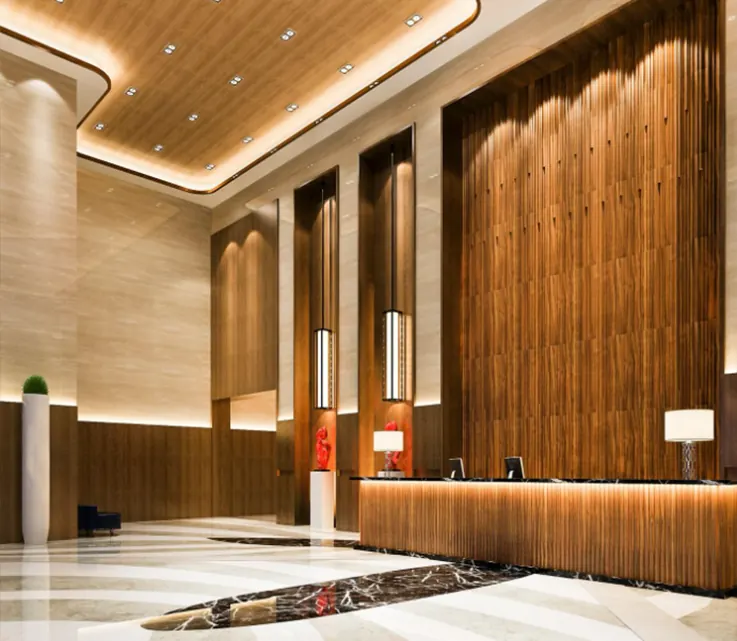
Short answer: a self-leveling coating is poured onto the floor and spreads by itself into a smooth, seamless layer whose thickness is measured in millimeters; DEMCO self-leveling products need 1.6–2.0 kg/m² of material per 1 mm of thickness. An orange-peel or textured coating is a thin, textured topcoat that is spread with a trowel and worked with rollers; one coat at 0.350–0.500 kg/m² gives a dry film of 200–300 µm, and its texture creates a slip-resistant surface. Choose self-leveling when you want a smooth, easy-to-clean, thick floor; choose a textured topcoat when slip resistance, a finish that can also go on walls and lower material use matter more. The two can also be combined in one system.
The values below are taken from the technical data sheets of DEMCO self-leveling and textured topcoat products.
The main differences at a glance
| Property | Self-leveling | Textured (orange-peel) topcoat |
|---|---|---|
| Application | Spread with a notched trowel or squeegee; air bubbles are removed with a spiked roller | Applied with the flat side of a trowel, worked with a satin roller and then with a coral roller |
| Consumption and thickness | Between 1.6 kg/m² (DEMCO EPOX 2000 SELF) and 1.8–2.0 kg/m² (DEMCO PUR 350 SELF) per 1 mm | 220–250 µm from one coat at 0.350–0.500 kg/m² (DEMCO EPOX 160 TIX) |
| Surface | Smooth, seamless from wall to wall and in one piece (DEMCO EPOX 2000 SELF) | Textured; semi-matte with DEMCO EPOX 187 TIX/W |
| Slip resistance | No slip-resistance value in the data sheets | Slip-resistant surface thanks to the texture; no slip-resistance class given in the data sheets |
| Vertical surfaces | Not suitable; runs and sags on vertical surfaces | Thixotropic; can be applied to horizontal and vertical surfaces without running |
| Abrasion (Taber, CS17, 1 kg, 1000 cycles) | ~40 mg (DEMCO EPOX 2000 SELF) · ~30 mg (DEMCO PUR 363 SELF) | ~35–40 mg (DEMCO EPOX 160 TIX) · ~30 mg (DEMCO EPOX 187 TIX/W) · ~30–35 mg (DEMCO PUR 382 TIX) |
Because the abrasion values were measured with the same test method, they are close to each other; the real difference is thickness. A 1 mm self-leveling layer is about four times thicker than a single 220–250 µm textured topcoat. In practice, on floors with heavy traffic and impact, the thicker layer leaves more wear allowance.
DEMCO self-leveling products
| Product | Type | Consumption per 1 mm | Data sheet note |
|---|---|---|---|
| DEMCO EPOX 2000 SELF | Solvent-free epoxy | 1.6 kg/m² | Medium to heavy mechanical and chemical exposure; warehouses, laboratories, hospitals, car parks; Shore D ~76 |
| DEMCO EPOX 2004 SELF/FAST | Fast-curing epoxy | 1.6 kg/m² | Floors that must be opened to traffic quickly; touch dry 3–4 hours, hard dry 5–6 hours |
| DEMCO EPOX 2700 SELF | Food-safe epoxy | 1.6 kg/m² | Meets the EU 10/2011 and TGK 2019/44 limits in migration tests carried out to EN 1186 |
| DEMCO EPOX 1900 SELF/C | Chemical-resistant epoxy | 1.6–1.8 kg/m² | Floors exposed to highly concentrated acids, bases and solvents |
| DEMCO PUR 350 SELF | Semi-elastic polyurethane | 1.8–2.0 kg/m² | High impact and tear strength |
| DEMCO PUR 360 SELF | Elastic polyurethane | 1.6–1.7 kg/m² | Floors that require elasticity |
| DEMCO PUR 363 SELF | Elastic polyurethane | 1.8–2.0 kg/m² | Not affected by sudden temperature changes; cold stores |
The data sheets give consumption per 1 mm; the thickness is set in the project according to the load on the floor. For example, a 2 mm layer of DEMCO EPOX 2000 SELF needs 3.2 kg/m² of material. The polyurethane self-leveling data sheets require the surface to be protected with one coat of an acrylic polyurethane semi-matte topcoat at 0.150 kg/m², against sunlight outdoors and against scratching and soiling indoors.
Textured (orange-peel) topcoats
The textured surface that the market calls orange-peel or textured coating appears in DEMCO data sheets as a "texture topcoat". DEMCO EPOX 160 TIX, DEMCO EPOX 187 TIX/W and DEMCO PUR 382 TIX are applied to a prepared and primed surface; because they are thixotropic, they do not run on walls either.
| Product | Type | Consumption and dry film per coat | Data sheet note |
|---|---|---|---|
| DEMCO EPOX 160 TIX | Solvent-free epoxy | 0.350–0.500 kg/m², 220–250 µm | Food areas, floors that need slip resistance, floors and walls of warehouses, shops and offices; Shore D ~73 |
| DEMCO EPOX 187 TIX/W | Water-based epoxy | 0.350–0.500 kg/m², 200–300 µm | Semi-matte and slip-resistant; permeable to water vapor; over DEMCO EPOX 100 PR or the water-based primer DEMCO EPOX 180 PR/W |
| DEMCO PUR 382 TIX | Solvent-free, semi-elastic polyurethane | 0.350–0.500 kg/m², 220–250 µm | Works together with the substrate; does not break or crack |
| DEMCO EPOX 2160 TİX ESD | Antistatic epoxy | 0.600–0.700 kg/m² | Slip-resistant and antistatic; applied over a conductive primer |
The data sheets give the consumption of one coat of textured topcoat; the number of coats and the total thickness are set in the project. For the layers of antistatic systems, see the ESD flooring guide.
An orange-peel look sometimes appears without being intended. According to its data sheet, DEMCO EPOX 155 TOP COAT /DK, which was developed for vertical surfaces, spreads little and may therefore create a slight orange-peel effect on horizontal surfaces. It is used on walls, stair risers and coving; on vertical surfaces it is applied at no more than 400 g/m² per coat, and it may run if this amount is exceeded.
Slip resistance: what do the data sheets say?
The data sheets of DEMCO EPOX 160 TIX, DEMCO EPOX 187 TIX/W and DEMCO PUR 382 TIX state that the textured finish gives a slip-resistant surface, but they do not give a slip-resistance class. The self-leveling data sheets describe the surface as having a "smooth finish" and contain no value for slip resistance.
If a specific slip-resistance class is required in wet areas, choose a system whose class is stated in its data sheet: the polyurethane concrete DEMCO PUR 303 CONCRETE SL 20 UB/WB is class R11 (EN 16165); details are in the food facility flooring guide. Outdoors, DEMCO PUR 413 TOP COAT UVS -R increases slip resistance by creating a rough surface and is UV-resistant. In practice, a deeper texture increases slip resistance but makes cleaning harder; agreeing on the texture on a small trial area is a good approach.
Appearance and cleaning
- Self-leveling: according to the data sheets it spreads well and gives a smooth surface; it is dust-free, hygienic and easy to maintain and clean (DEMCO EPOX 2000 SELF, DEMCO EPOX 2700 SELF).
- Textured topcoat: according to the data sheet of DEMCO EPOX 187 TIX/W it is easy to clean, does not harbor bacteria and does not create dust; it resists cleaning detergents and disinfectants. DEMCO EPOX 160 TIX prevents dusting of the surface it is applied to.
- In practice: on a textured surface, dirt holds in the hollows of the texture, so a scrubber with brushes works better than a mop. A smooth self-leveling surface is easily cleaned with a mop or a machine.
Which one for which area?
| Area or need | Choice | DEMCO product |
|---|---|---|
| Warehouse, production area, laboratory, car park | Self-leveling epoxy | DEMCO EPOX 100 PR primer + DEMCO EPOX 2000 SELF |
| Floor to be opened to traffic quickly | Fast self-leveling | DEMCO EPOX 114 PR – FAST primer + DEMCO EPOX 2004 SELF/FAST |
| Food production and storage, smooth surface | Food-safe self-leveling | DEMCO EPOX 2700 SELF |
| Food areas, warehouses, shops and offices that need slip resistance | Textured topcoat | DEMCO EPOX 160 TIX · DEMCO EPOX 187 TIX/W |
| Slip resistance and working together with the substrate | Semi-elastic textured topcoat | DEMCO PUR 382 TIX |
| Impact, elasticity, cold stores | Polyurethane self-leveling | DEMCO PUR 350 SELF · DEMCO PUR 363 SELF |
| Walls, stair risers, coving | Topcoat for vertical surfaces | DEMCO EPOX 155 TOP COAT /DK; DEMCO EPOX 160 TIX for a textured surface |
| Outdoor areas, sunlight and slip resistance | Rough UV topcoat | DEMCO PUR 413 TOP COAT UVS -R |
Using both in one system
If both thickness and slip resistance are needed, the layers can be combined. DEMCO EPOX 2001 SELF/MID COAT is a filled, self-leveling intermediate and scratch coat; according to its data sheet, the desired topcoat is applied once it is hard to the touch. The data sheet of DEMCO EPOX 213 REPAIR describes it as a leveling and correction layer in the food industry before smooth or textured finishes; it can be overcoated after 12–24 hours. The textured topcoat goes on top of these layers. For the order of the layers and the waiting times, see the guide How to apply epoxy floor coating.
Frequently asked questions
Is self-leveling epoxy slippery?
DEMCO data sheets describe the self-leveling surface as a smooth finish and give no slip-resistance value. If slip resistance is needed in wet or oily environments, choose a textured topcoat or a system whose slip-resistance class is stated in its data sheet.
How thick is an orange-peel coating?
DEMCO EPOX 160 TIX and DEMCO PUR 382 TIX give a dry film of 220–250 µm (about 0.22–0.25 mm) per coat, DEMCO EPOX 187 TIX/W 200–300 µm. The number of coats is set in the project.
Which one needs less material per square meter?
The textured topcoat: 0.350–0.500 kg/m² per coat. Self-leveling needs 1.6–2.0 kg/m² for every 1 mm. The total cost depends on thickness, number of coats and substrate preparation; details are in the floor coating cost per square meter guide.
Can an orange-peel coating be applied to walls?
Yes. DEMCO EPOX 160 TIX, DEMCO EPOX 187 TIX/W and DEMCO PUR 382 TIX are thixotropic; they can be applied to horizontal and vertical surfaces without running. DEMCO EPOX 155 TOP COAT /DK, developed for vertical surfaces, is applied to walls at no more than 400 g/m² per coat.
Can an existing smooth floor be made slip-resistant?
The data sheets describe applying textured topcoats to a prepared and primed surface; for application over an existing coating, our technical team defines the surface preparation. Outdoors, the data sheet of DEMCO PUR 413 TOP COAT UVS -R states that it can be applied over epoxy, polyurethane and polyurea coatings where necessary.
For the daily care and cleaning of these surfaces, see Epoxy Floor Coating Maintenance and Cleaning.
Describe how the area is used, the type of traffic, whether it is wet and the look you want in the quote form, and our technical team will recommend a suitable system. For all products, see the flooring page.